Douglas Carswell
A new monetary policy?
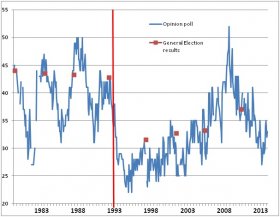 Here is a graph showing the Conservative party share of the vote each month since 1979. The red squares mark the party's share of the vote in each General Election along the way.
Look at the vertical red line – which marks the day Britain left the European Exchange Rate Mechanism. What do you notice?
Before ERM exit, the party polled over 40 percent in 35 of the 60 previous monthly polls. In the 60 months that followed, the Tory party failed to poll above 40 percent even once. In fact, according to Ipsos MORI, they did not make it above 40 percent for another 13 years!
Of course it wasn't just ERM exit. There were various sleaze scandals, John Major's petulant leadership, not to mention the initial electoral attractiveness of Tony Blair. But in a paper published by Politeia on Wednesday, I suggest that ERM exit was an enormously significant event since it revealed the hollowness of Tory economic policy.
Throughout the 1980s, the Tory party possessed – or was believed to possess – a coherent monetary policy. If many people, Tory MPs included, did not necessarily understand the minutiae of monetarism, the party seemed to have a credible sense of how to run things. ERM exit was devastating because it showed otherwise.
Monetarist certainties had, of course, been quietly ditched some time before ERM exit. In the mid to late 1980s, Nigel Lawson had begun to shadow the Deutschemark with his "exchange rate monetarism". From that, we drifted into and then out of ERM.
Still without a coherent, free market idea of what monetary policy might be, we had nothing to say as the Gordon Brown bubble inflated. Like Brown, we too mistook the increase in output, caused by all that cheap credit, as sustainable growth. We, too, believed that all the additonal revenue flowing into the Treasury coffers was a permanent addition to the tax base.
Nor have we had much to say since the Brown bubble burst. Indeed, in my paper After Osbrown I suggest that we have been left offering many of the same "candyfloss credit" solutions.
Hosing cheap credit at the economy a second time round will no more achieve sustainable growth than it did the first. What we need is neither Continuity Brown nor reheated monetarism. Instead we need something that the Tory party has not had for a very long time; a coherent, free market way of managing the money.
In my paper, launched this Wednesday in the House of Commons, I try to suggest what that might entail.

 RSS Feed
The End of Politics and the Birth of iDemocracy
"A revolutionary text ... right up there with the Communist manifesto" - Dominic Lawson, Sunday Times
Printed by Douglas Carswell of 61 Station Road, Clacton-on-Sea, Essex
