TalkCarswell.com
Douglas Carswell's Blog
Conservatism and the internet
"The internet?!" asks Homer Simpson "Is that thing still around?"
There may no longer be many old school Tories left at Westminster for whom the interweb could be dismissed as a passing fad. But even among those who are self-consciously "modernisers", few seem to have really thought through the implications of the digital revolution on human social and economic affairs.
Far too many Conservatives seem to see the internet is a threat. It is, they imagine, the Wild West, in need of new regulation and government control.
There is, alas, no shortage of vested interests only too keen to promote this view. In business, banking, journalism or the entertainment industry, established players find that the barriers to entry are coming crashing down. Many of the lobbyists that throng SW1 do so in the pay of those keen to keep out the nimble upstarts that the internet allows to compete successfully.
Without order imposed from above, they seem to presume, there would be chaos and anarchy down below. Yet the evidence suggests the opposite. Far from disorder, an absence of design imposed from on high produces spontaneous order from below. Think Wikipedia.
Conservatives need some serious thinking about the internet, and how it is going to change human social and economic affairs. Instead of asking what government needs to do to manage the internet, we ought instead ask how the internet might change what government itself does.
If we can suddenly do a lot of collectivism without the state, why have such a big state?
The internet will in some ways be unconservative, in the sense that it will change a lot of the established ways of doing things. Payments could be made without banks. Politics could increasingly be done without political parties. The workers really could own the means of production - and distribution and design.
But in another sense, it will make the world profoundly more conservative.
Public policy will increasingly be determined not by public officials deciding what good policy looks like, but by the actions of the public themselves. After years of fighting the long retreat, small state conservatism will win the big macro debates of the future.
The Conservative movement has long been an awkward compromise between the authoritarians, keen to use state fiat to impose conservative ends, and libertarians, who believe that state fiat is the problem. Perhaps in the short term, the internet will exacerbate the tensions between those on the centre right who presume to know what works, and those who are on the centre right because they know that they cannot know what works.
Too many MPs I listen to talking about the internet still tend to see it all in terms of how it revolves around them. How many followers they have on twitter. How email helps them communicate with voters. Blah blah.
Perhaps the real significance of the internet is that fewer and fewer things will revolve around politicians at all.
blog comments powered by Disqus
 RSS Feed
The End of Politics and the Birth of iDemocracy
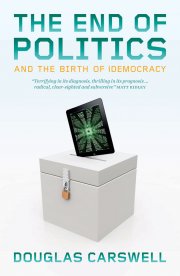
"A revolutionary text ... right up there with the Communist manifesto" - Dominic Lawson, Sunday Times
Printed and promoted by Chris Lowe on behalf of Douglas Carswell, both of 105 Station Road, Clacton-on-Sea, Essex
