Douglas Carswell
Russell Brand has a point. Democracy is in retreat
 Britain is more of a democracy now than in the past. Right?
Everyone knows we've been getting steadily more democratic. First working men got the vote. Then women. There's even talk of giving it to 16-year-olds.
The proportion of the population entitled to vote has undoubtedly increased. But what about their ability to hold those with power to account?
Measured that way, democracy has been in retreat.
Look at a political map of Britain today and you will see a mosaic of local party monopolies – 21st-century "rotten boroughs". In seven out of ten parliamentary constituencies, there is almost no chance that the seat might change hands between parties at a General Election. Yet within most of these safe seats, it is the party machines and cliques that control candidate selection (think Falkirk). They do so as tightly as any local duke or landowner once did.
The uncomfortable truth is that most folk still do not have a real say over who gets to represent them in Parliament.
Many MPs answer not to their constituents, but to the party machine and other MPs. And because of this, the executive has been steadily able to neuter the legislature. Those we elect to hold government to account find that they are accountable to government.
Ponder for a second what really kicked of the English civil war. It was the king's insistence that he be able to appoint ministers without reference to the Commons. But isn't that more or less what the Prime Minister now does?
Until the mid 1970s, it was Parliament, not the Prime Minister that decided the scope of ministerial responsibilities. Far from being a quirky leftover from the past, the powers of Crown Prerogative have been extended.
From 1701 until 1918, it wasn't just Parliament that approved what ministers did. Local voters were required to approve who became a minister in the first place. Once invited to join the government, an MP would have to return to their consistency, resign their seat, then fight and win the by-election that followed. There might have been fewer voters in each constituency, but they were able to approve ministerial promotion.
Whichever clique happens to be sitting on the Downing Street sofas gets to decide who becomes a minister and what they do as a minister – not the people you actually vote for on polling day.
Within living memory, the Commons controlled its own agenda. Today a committee of the executive decides what those you elect should be allowed to decide (with a little time for tame Backbench Business blah blah, you understand).
Until the 1930s, those we elected could table amendments to the Budget – in other words make real tax and spend decisions. Today MPs are invited to say "yes" or "no" to a Budget drafted in Whitehall, which few of them have even read, let alone understood.
More people might have the vote. The ability of voters to determine public policy has steady declined. No wonder so many people no longer bother with the whole process.
Russell Brand is right to recognise this. The solution, however, is not to give zillionaire celebs a greater say. We need more direct democracy, with open primaries and recall votes, so that ordinary folk with votes might actually have votes that count.
 RSS Feed
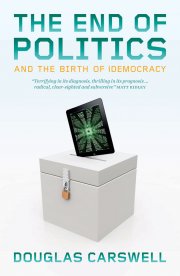
The End of Politics and the Birth of iDemocracy
"A revolutionary text ... right up there with the Communist manifesto" - Dominic Lawson, Sunday Times
Printed by Douglas Carswell of 61 Station Road, Clacton-on-Sea, Essex
