TalkCarswell.com
Douglas Carswell's Blog
The government's macro economic policy is wrong
And on it goes. Another £50 Billion of money is to be printed and shuffled between central banks and investment banks. This latest round of QE – or Quantitative Easing - is, they tell us, needed to rescue the economy and make us prosperous once again.
If it was so easy, why not print off £500 billion and make us even richer?
According to the Bank of England and Treasury “experts” who run our economic policy, all this extra funny money – along with low interest rates – will mean more credit. And more credit will produce economic growth.
Except this orthodox Whitehall view – which ministers have done nothing to challenge – is being proved wrong, just like Treasury thinking turned out to be in the early 1970s.
Those who believe that cheap credit is the economic cure-all have misdiagnosed the cause of our malaise. Seeing a shortage of credit, they believe that if only government was to ensure the supply of more credit, all would be well. It is the intellectual equivalent of using a prices and incomes policy to try to curb inflation.
The truth is that the “credit crunch” was caused by the credit boom that preceded it. During the boom years, bogus credit – conjured up as deliberate policy - caused chronic malinvestment, which the Treasury mistook for growth. I sometimes fear if there can be a return to growth without that malinvestment unwinding first.
Simply pumping artificial money into the system is not going to prevent the inevitable contraction that will now follow. Fixing the price of credit artificially low will do nothing to allow the build up of real credit. Thus do we end up with low interest rates, little real credit and economic stagnation.
In the 1970s, government policy produced a condition known as stagflation – stagnation and inflation. Today government policy is giving us stagnation + low rates – or stagrates.
Far from curing the patient, government’s macro economic policy is making the patient more ill.
In 1976, Jim Callaghan famously called time on the fiscal stimulus orthodoxy. Who, I wonder, will call time on the monetary stimulus approach and when? A new generation of Conservative thinkers are feeling their way towards a post monetary stimulus approach.
blog comments powered by Disqus
 RSS Feed
The End of Politics and the Birth of iDemocracy
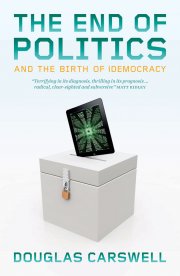
"A revolutionary text ... right up there with the Communist manifesto" - Dominic Lawson, Sunday Times
Printed and promoted by Chris Lowe on behalf of Douglas Carswell, both of 105 Station Road, Clacton-on-Sea, Essex
