TalkCarswell.com
Douglas Carswell's Blog
What if the borrowing runs out?
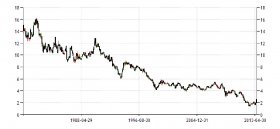 UK bond yields have risen sharply since May. What does this mean?
When the government wants to borrow money, they write out an IOU, or a bond. As the yield, or interest, on the bond rises, the amount the government has to pay to borrow rises.
This can have big consequences. Already, in 2014, the government will spend more on debt interest payments - £46 Billion - than it is spending of UK defence - £45 Billion.
But, many folk will say, even with the bond yield spike, borrowing is extremely cheap by historic standards.
Indeed. As the graph shows, the cost of borrowing for the government has fallen pretty consistently since 1980. And is very low - even with the recent rises.
Take another look at the graph. What would happen if we were to return to mid 1990 borrowing costs? Or to mid 1980 bond yields? What would things look like then?
I asked the Chancellor about this during Treasury questions today. I am none the wiser. I suspect that the Treasury would rather not think about it. "How were we supposed to know" I suspect Treasury officials will one day say.
blog comments powered by Disqus
 RSS Feed
The End of Politics and the Birth of iDemocracy
"A revolutionary text ... right up there with the Communist manifesto" - Dominic Lawson, Sunday Times
Printed and promoted by Chris Lowe on behalf of Douglas Carswell, both of 105 Station Road, Clacton-on-Sea, Essex
