Douglas Carswell
Where is the serious thinking in government?
It was one of those watershed moments. Rev Paul Flowers, chairman of the Co-operative Bank, was asked by the chairman of a Commons committee if he knew the total asset value of the Co-operative Bank.
About £3 billion, he ventured. In fact, the total asset value of the bank over which he presided was £47 billion.
Before that moment, you would have been forgiven for assuming that those who sit on the boards of the big banks knew what they were doing. Afterwards, it was obvious that corporate governance was not merely a problem at the Co-Op bank.
Far from being wise and competent, what if City board rooms were full of people who looked and dressed the part, but thought and talked in clueless cliché? Those we once assumed to be capable and competent started to seem anything but.
I wonder if we will have a similarly revealing moment in politics, too.
Just like with banking, we take it for granted that those at the top in Westminster know what they are doing and why they are doing it. They are, after all, at the top. It is their job to think hard about public policy. So they must have done so, right?
A couple of days ago, the Times wrote about a new book, Inside the Nudge Unit. It is the story of the Whitehall behavioural insights team. Housed in the heart of government, this team has been able to improve the way we are governed. One of its big successes, the Times told us excitedly, has been to change the wording on letters sent out with tax returns. This has improved the rate of returns by several percentage points, apparently.
Great. But where is the new thinking about the big picture issues? Where is the unit in Downing Street thinking about how we might respond to the mass mass movement of people across the Mediterranean? What, besides more fences for Calais, do ministers propose we actually do?
Like the Co-Op board, government seems to have detailed policies on issues of relatively minor significance, but little grip on some fundamentals.
The economy is growing again. The politicos who preside over us are keen that we should thank them for it. Yet, just as we have done for decades, the increase in output is largely driven by consumption. It is a rise in output conjured up with cheap credit. We continue to live beyond our means by issuing IOUs.
Several years after the banking bubble burst, who in government is giving serious thought to monetary alternatives and real bank reform? Ministers are keen to dress in hard hats, but are they prepared to ask the kind of questions that will need answering if we are to actually rebalance the economy?
Corporate governance means scrutinising those who run things. Just as a bank needs good corporate governance, so does a country.
If the chairman of the bank does not know the total asset value of the business, why even talk about banking ethics? If ministers cannot control our borders, why are they worrying about being able to control sea levels?
The business of government has become too big and bloated. Government needs to de-clutter. Ministers need to understand the core business of government.
Giving an additional £3 million to embattled charity, Kids Company, would not help "deliver the outcomes for which the department is funded by Parliament", the head of the Cabinet Office warned ministers recently. It did not stop them handing out the money.
Perhaps ministers need a far sharper sense of the outcomes government is there to achieve – and then some grown up thinking about how to achieve them.
 RSS Feed
The End of Politics and the Birth of iDemocracy
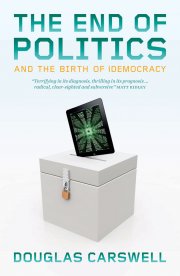
"A revolutionary text ... right up there with the Communist manifesto" - Dominic Lawson, Sunday Times
Printed by Douglas Carswell of 61 Station Road, Clacton-on-Sea, Essex
